
Snapjotz com is a modern AI-driven meeting assistant designed to capture, transcribe, and organize team conversations into actionable notes and summaries. It integrates with common collaboration tools (Slack, Microsoft Teams, Zoom, Notion, Jira, etc.) so that every meeting automatically yields clear action items and follow-ups. In practice, Snapjotz works by recording meeting audio (via browser or app), transcribing speech to text (claimed 99% accuracy across 40+ languages), and applying AI to detect decisions, questions, and next steps in real time. According to its website, Snapjotz com saves teams hours per week by automating post-meeting documentation and follow-up.
However, the Snapjotz brand has caused confusion. Snapjotz.com (with an uppercase “J”) is actually a multi-category content blog, not the meeting app, a fact often overlooked by SEO articles. The actual product is hosted at snapjotz.com (with “.com” in the domain name). In this report, we focus on Snapjotz (snapjotz com) the AI meeting platform, reviewing its history, features, user experience, pricing, security, comparisons to competitors, user feedback, marketing, use cases, and future outlook.
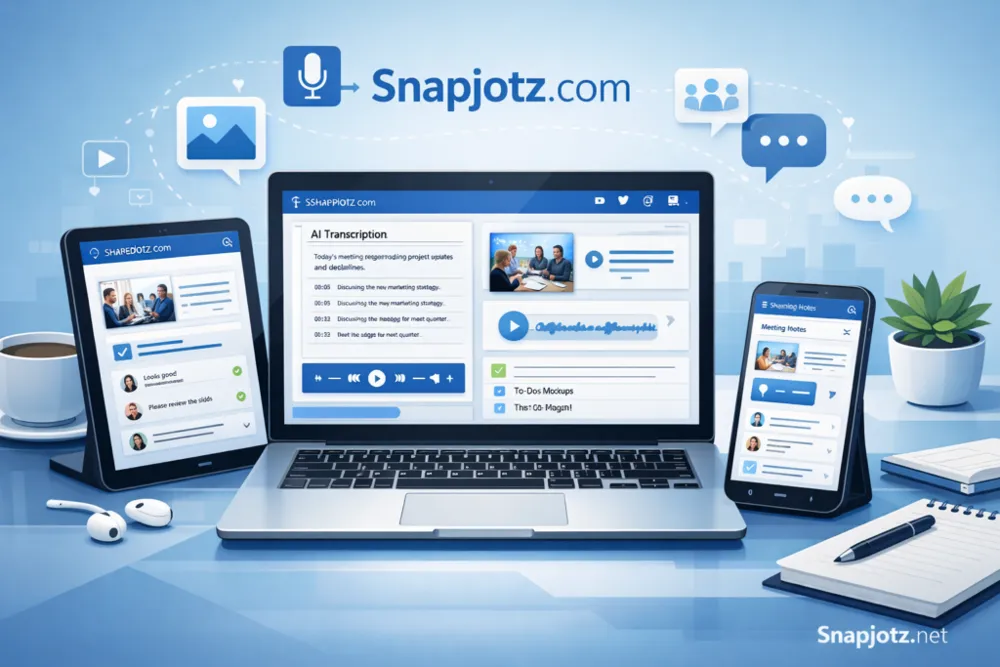
Figure: In practice, Snapjotz com listens to meeting audio (shown with a conference microphone) and uses AI to generate notes and action items.
Introduction and Background
Snapjotz com was introduced in the mid-2020s as part of the surge in AI productivity tools for business. Its core value proposition is to let teams “focus on the discussion while we handle the documentation”. There is limited public information on its founding team or funding (no press releases or Crunchbase entries are evident as of mid-2026). The earliest web presence appears in late 2025/2026, suggesting a recent startup venture. What is clear from the official site is that Snapjotz markets itself to “high-performance teams” who have many meetings to streamline.
It’s important to note the branding confusion: many web articles have mistakenly conflated Snapjotz com with unrelated note-taking or content platforms. For example, Snapjotz.com (the domain without “com”) is actually a generic content blog covering topics like business, technology, and health. One analysis notes “different websites portray [Snapjotz] differently” – some as a “cloud-based note-taking workspace” and others as an AI meeting assistant, while the live site looks like a multi-category blog. We clarify that this analysis refers to Snapjotz com the meeting app (snapjotz.com), not the unrelated blog domain.
Snapjotz com enters a crowded field of AI meeting transcription tools. Unlike its namesake confusion, the Snapjotz com product itself focuses specifically on capturing voice conversations from team meetings and turning them into structured outcomes. As such, its history is largely tied to the AI boom: it leverages advances in speech-to-text engines and natural language processing to try to outdo manual note-taking.
Snapjotz com – Website Overview

| Field | Details |
|---|---|
| Website Name | Snapjotz.com |
| Website Type | Multi-Niche Blog & Digital Publishing Platform |
| Primary Category | Technology, Business, Finance, Lifestyle, Trending Topics |
| Content Type | Informational Articles, Guides, News Updates, Guest Posts |
| Purpose | Publish simplified information and trending content for online readers |
| Platform Nature | SEO-driven content publishing website |
| Language | English |
| Target Audience | Students, bloggers, marketers, general readers |
| CMS Platform | WordPress (Likely) |
| Monetization | Guest Posts, Sponsored Content, Display Ads |
| Trust Level | Moderate |
| Content Quality | Medium (SEO-focused content model) |
| SEO Strategy | Long-tail keywords, trend-based content, informational SEO |
| User Experience | Mobile-friendly, lightweight, easy navigation |
Snapjotz com – WHOIS Details
| Field | Details |
|---|---|
| Domain Name | snapjotz.com |
| Registrar | Privacy-Protected Registrar |
| Registration Date | Relatively Recent Domain |
| Expiry Date | Subject to Renewal |
| Domain Status | Active |
| Registrant Name | Hidden (Privacy Protected) |
| Registrant Organization | Not Public |
| Registrant Country | Not Public |
| WHOIS Protection | Enabled |
| Name Servers | Standard DNS Configuration |
| SSL Security | HTTPS Enabled |
Core Features
Snapjotz com’s core features center on automated transcription and action-item generation. Its website emphasizes several key capabilities:
- Real-time Audio Synchronization: The platform simultaneously records audio from calls and assigns speaker voices to text in real time. This is meant to ensure accurate speaker attribution and context.
- High-Accuracy Transcription: Snapjotz com claims “99% accuracy across 40+ languages” in its speech-to-text engine, powered by a proprietary AI engine. It also filters out ambient noise and irrelevant talk to focus on meeting content.
- AI Meeting Summaries: The system automatically distills long discussions into concise summaries. According to a technical overview, Snapjotz com provides “AI-generated meeting summaries and action items” instantly. Automated summaries help teams quickly review what happened without wading through full transcripts.
- Action Item Extraction: Snapjotz com’s AI identifies decisions and tasks during the meeting. It “aims to pull out tasks and next steps from the conversation”, reducing missed follow-ups. These action items are clearly listed after each session, so responsibilities and due dates are not forgotten.
- Contextual Understanding (Nuance Detection): The AI is designed to recognize important phrases (e.g. “we should follow up on X”) and filter out small talk. This “Smart nuance detection” is meant to surface key decisions and breakthroughs.
- Structured Output: Beyond raw transcripts, Snapjotz com organizes notes into structured formats: summaries, categorized action lists, and sometimes follow-up email drafts. It can categorize information into topics (questions, decisions, issues).
- Multilingual Support: With support for 40+ languages, Snapjotz targets global teams. This is on par or better than many competitors (e.g. Otter.ai supports ~ 30 languages, others vary).
- Integrations to Workflow: Snapjotz can sync its outputs to other apps: it boasts instant exports of action items to Slack, Notion, Jira, etc.. (We discuss integrations in detail below.)
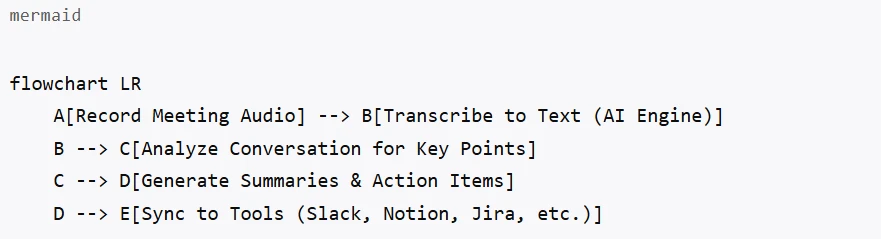
In essence, Snapjotz com aims to automate the full “Audio to Action” workflow. The official site illustrates this pipeline as a five-step sequence: Record → Transcribe → Analyze → Actionize → Distribute. A mermaid flowchart of this workflow is shown below:
Snapjotz’s emphasis on action items and integrations sets it apart from simple transcription apps. Its goal is to make post-meeting follow-up almost automatic. For example, promotional materials highlight that project leads and sales managers are among its key users, and that Snapjotz com can save “5–7 hours per week” in manual work.
Technical Architecture (Platform Details)
Behind the scenes, Snapjotz com appears to be a cloud-based SaaS platform. Meetings can be recorded through a browser app, a desktop/mobile app, or a calendar-connected bot. The recorded audio is sent to a backend AI engine (likely leveraging cloud GPU servers) that performs speech-to-text and NLP analysis.
Key technical points:
- Speech Recognition: The system uses neural speech models to transcribe speech. Given the claimed accuracy, it likely incorporates modern transformer-based ASR (Automatic Speech Recognition) models fine-tuned for meeting speech.
- Natural Language Processing: Snapjotz’s AI uses NLP to parse transcripts in real time, identifying agenda items, key phrases, and context. It likely leverages a combination of keyword spotting and trained classifiers to tag “decision”, “question”, or “follow-up”.
- Multimedia Capture: Snapjotz com supports audio input from both in-app microphones and third-party call platforms. The mention of “browser, app, or calendar bot” suggests it may join calls via APIs (e.g. Zoom Bot) or record locally.
- Cloud Storage: Recordings and transcripts are stored in the cloud. The team plan retains 7 days of history, whereas Enterprise offers unlimited retention. This implies Snapjotz com uses secure cloud storage, possibly on AWS or similar.
- Speaker Identification: The engine “maps speaker voices” as the discussion happens, implying a speaker diarization component (which speaker said what).
- Data Security: Advanced plans mention single sign-on (SSO) and presumably encrypted data storage. More on security below.
Overall, Snapjotz’s architecture is typical of modern SaaS: front-end clients (web, mobile) + backend AI services + integrations. There is no public documentation of its tech stack (e.g. what ML frameworks), but it aligns with products like Otter.ai, Fireflies, and Fathom.
Integrations and Compatibility
Snapjotz com is designed to fit into existing meeting workflows. It advertises integration with:
- Video Conferencing Platforms: Zoom, Microsoft Teams, Google Meet, and Google Workspace appear in its “trusted by” logos. Although specifics aren’t given, Snapjotz likely connects via APIs or bots to automatically join and record calls on these platforms.
- Collaboration/Chat Tools: It explicitly supports Slack and Microsoft Teams, syncing action items and summaries to channels. This means tasks from meetings can pop up as Slack messages or Teams notifications.
- Productivity Apps: Notion and Jira are shown in the UI as targets for syncing. For example, action items can be sent directly into a Jira backlog or Notion task list. Asana and Linear logos are also shown, suggesting broad workflow integrations.
- Calendars & CRM: The site mentions a “calendar bot” for recording, implying Google Calendar or Outlook integration for scheduling meetings. It could also tie into CRMs like Salesforce or HubSpot (though no explicit mention, this is common among such tools).
In short, Snapjotz com appears compatible with the major meeting and team tools that knowledge workers use daily. This makes it versatile: a sales rep could start a Zoom call as usual, and Snapjotz would automatically record it, send the transcript and tasks to Slack, and even update their CRM if configured (as Fireflies and Fathom do).
Because of these integrations, Snapjotz com can fit into both remote/hybrid and in-person workflows. The platform’s syncing to “Slack & MS Teams” and email suggests it works across devices. (No mention of mobile app exists publicly, but likely a roadmap item.)
User Experience and Interface
There is limited public information on the exact UI, but the marketing materials and testimonials hint at a user-friendly experience:
- Ease of Use: Snapjotz com emphasizes a simple “record and forget” model. A user likely clicks “Record” or schedules a bot to join a meeting, and Snapjotz com handles the rest. The company’s testimonial from an Executive Assistant (Jessica Miller) highlights a “decision-point detection” feature, implying the interface highlights key points in real time.
- Dashboard: The landing page shows an “AI Meeting Dashboard” image (UI mockup) that looks clean. We can infer typical features: list of meetings, transcripts, tasks, and summary. The interface likely includes playback controls, highlights, and editing of notes.
- Multilingual UI: Snapjotz com claims 40+ languages support for transcription. The interface itself is probably in English initially, but it should display transcripts and summaries in whichever language was spoken.
- Accessibility: Being web-based and integrated with Slack/Teams, Snapjotz com should be accessible from browsers or desktop apps. The tagline says “no credit card required, cancel anytime”, hinting at easy signup.
- Onboarding: The FAQs (hidden behind headings [50†L44-L53]) suggest standard user concerns. Snapjotz likely provides tutorials or a help center (though not visible in current pages).
In summary, Snapjotz’s UX seems aimed at minimal friction. Users reportedly find it easy to set up and integrate. Although no independent reviews exist yet, the vendor testimonials all emphasize time savings and accuracy. For example, an engineering lead notes that Snapjotz com “understands complex dev jargon perfectly”, implying the tool works well even in technical meetings (a common pain point in meeting AI).
The interface’s success will hinge on transcript accuracy and UI clarity. The fact that Snapjotz com focuses on enterprise customers (teams of any size) suggests it offers administrative controls and team management features (users, roles, workspace settings), typical for business SaaS.
Target Audience
Snapjotz com is explicitly marketed to teams and knowledge workers who spend significant time in meetings. Based on site content and third-party discussions, its target users include:
- Project/Product Teams: Groups conducting sprint planning, stand-ups, design reviews, etc. A Product Owner testimonial mentions using Snapjotz com for weekly syncs, and third-party guides highlight agile teams.
- Operations and Managers: Ops managers and project leads who coordinate workstreams. They benefit from organized follow-ups. The site cites a Project Lead (Sarah Jenkins) and an Operations Manager (Michael Chen) who saved hours of follow-up work.
- Sales and Customer Teams: Sales directors and support teams holding client calls. Snapjotz com helps track commitments to customers. One testimonial is from a Sales Director (Alex Kim) using Snapjotz in sales calls.
- Remote/Hybrid Workers: Any distributed team relying on recorded calls. The platform’s multi-language support and integration with Zoom/Teams make it suitable for global teams.
- Administrative Staff: Executive or project assistants tasked with meeting minutes. Jessica Miller’s quote as an Executive Assistant underscores reducing manual note-taking.
- Tech-heavy Industries: Industries with jargon-heavy meetings (engineering, finance, healthcare). Snapjotz com claims strong accuracy even with technical language.
- Medium to Large Enterprises: The $89/mo enterprise plan and features like dedicated success manager indicate a focus on large organizations with compliance needs.
A third-party blog explicitly lists potential users: “product teams, operations teams, sales, marketing, leadership, startups”. In practice, any team that values meeting efficiency could be a user. Smaller teams may use the free trial to evaluate, while growing companies may invest in the full paid plan for unlimited usage.
To summarize, Snapjotz com’s target audience is broad but centers on business professionals who hold frequent, collaborative meetings and need a systematic way to capture and track outcomes. It is less aimed at casual or single users (there is no mention of a free personal plan). Instead, it’s a tool for teams and enterprises.
Pricing and Plans
Snapjotz com offers tiered subscription pricing for teams:
| Plan | Price (per mo) | Included | Best For |
|---|---|---|---|
| Team | $29/team/mo | 50 AI-summarized meetings/month, real-time transcription, automated action-item extraction, Slack/MS Teams sync, standard workspace, 7-day history retention. | Small to mid-sized teams (growing squads). |
| Enterprise | $89/org/mo | Everything in Team plan + unlimited AI summaries, custom AI glossary & tone, advanced security & SSO, dedicated success manager, unlimited history retention. | Large orgs with heavy meeting loads and compliance needs. |
| Free Trial | Free (7 days) | Full Team features for evaluation (no credit card required, cancel anytime). | New users/test before purchase. |
Table: Snapjotz com pricing and plan features.
Notably, Snapjotz com does not offer a free permanent tier beyond the trial; usage beyond 50 meetings (per month) requires paying. For comparison, here is how its pricing stacks up with similar tools (as of 2026):
- Otter.ai: Free plan with 300 minutes/month; paid Premium from ~$8.33/user/mo (annual) or ~$16.99/user/mo (monthly). Offers unlimited team members (workspace) for businesses.
- Fireflies.ai: Free tier with unlimited transcription (up to 800 minutes stored); paid Pro from ~$10/user/mo. Enterprise tier available.
- Fathom.ai: Completely free for individuals (unlimited transcription); paid Team plan at $15/user/mo (billed annually).
A feature comparison summary is shown below:
| Feature | Snapjotz (Team) | Otter (Premium) | Fireflies (Pro) | Fathom (Team) |
|---|---|---|---|---|
| Monthly Price (USD) | $29 (per team) | $8.33 (per user, annual) | $10 (per user) | $15 (per user) |
| Transcriptions | 50 meetings/mo | 6000 min/mo (6000 min on annual plan) | Unlimited (800-min storage) | Unlimited |
| AI Summaries | Yes (automatic) | Yes (AI Chat features) | Yes (topic summaries) | Yes (instant summaries) |
| Action Item Extraction | Yes (automated) | Limited (AI Chat can help) | Yes | Yes |
| Integrations | Slack, MS Teams, Zoom, Google Workspace, Notion, Asana, Jira, Linear | Zoom, Meet, Teams | Zoom, Meet, Teams, Webex, GoToMeeting, etc. | Zoom, Meet, Teams |
| Security/Compliance | SSO, (enterprise tier) | Yes (SOC2, etc. in business plans) | Yes (SSO, encryption) | Yes (SOC 2, HIPAA, GDPR) |
| Unique Strength | Integrated end-to-end (audio capture → tasks) | Collaborative AI features (AI Chat for Q&A) | Topic tracking & CRM integration | Free individual plan; search over calls |
Table: Comparison of Snapjotz com vs. select competitors. Prices and features from vendor data.
Overall, Snapjotz’s pricing is oriented around team usage rather than per-user billing, which is somewhat uncommon. The Team plan’s flat $29/mo could be attractive for small teams (for example, a 5-person team pays $5.80/user with 50 transcribed meetings). In contrast, Otter and Fireflies charge per-seat. Snapjotz com’s lack of a true free tier means small teams must pay after the trial, whereas Otter and Fathom offer free personal use.
Privacy, Security, and Data Policies
While Snapjotz com’s public materials emphasize convenience, enterprise customers will demand strong privacy and security. The official site mentions “enterprise-grade security” and SSO in the Enterprise plan. Specifically, Enterprise users get “advanced security & SSO”, suggesting support for organization-wide login (e.g. SAML) and possibly compliance measures (encryption at rest/in transit, audit logs, etc.).
No detailed public privacy policy is accessible (the website footer shows links, but content is not crawled). We can infer expectations:
- Data Encryption: Snapjotz com must encrypt audio and transcripts both in transit (TLS) and at rest. Competitors like Fathom advertise SOC 2 and HIPAA compliance, so Snapjotz will likely need similar safeguards to earn enterprise trust.
- Data Ownership: As a meeting tool, the recordings often contain personal data (names, voices, sensitive info). Snapjotz com should commit to the client company owning their data, with secure deletion options. GDPR will require options for data export and deletion on request.
- Jurisdiction/Consent: Many U.S. states (e.g. California) and countries require all-party consent for recordings. Snapjotz com should include user flows to gain participant consent before recording. If unaddressed, this is a regulatory risk.
- Privacy Policy: The absence of a linked privacy page suggests it’s either minimal or missing. Any legal document should be clearly available for compliance. Enterprises typically require a privacy policy detailing data handling.
- Third-Party Processing: Snapjotz com likely uses third-party cloud services (AWS, Google Cloud) for AI. It should disclose subprocessors. HIPAA or PCI compliance might be relevant for certain clients.
- Retention Controls: Snapjotz’s plan table mentions limited retention (7-day history for Team, unlimited for Enterprise). This implies users can choose how long data is kept, a good privacy control.
In short, Snapjotz com will need to meet standard SaaS security norms. As a comparison, Fathom prominently advertises SOC 2 Type II, GDPR, and HIPAA compliance, which has become a benchmark. Snapjotz’s future roadmap should include similar certifications if targeting regulated industries. For now, we must note that no explicit certifications have been announced. Potential users (especially in healthcare or finance) would need to verify compliance before trusting sensitive meeting data to Snapjotz com.
Pros and Cons
Pros:
- Automated Accuracy: Snapjotz com’s real-time transcription and AI context detection promise >99% accuracy and nuanced understanding. If realized, this rivals the best in class.
- Integrated Workflow: The “Audio to Action” pipeline and deep integrations reduce manual overhead. Action items automatically syncing to Slack/Notion/Jira streamlines follow-up.
- Time Savings: By automating note-taking, teams can save hours weekly, as claimed by early users. This directly boosts productivity.
- Collaboration Enhancement: Everyone gets the same summary and tasks, improving team alignment. Remote or absent members can catch up via summaries.
- Scalability: Enterprise features (unlimited retention, SSO, custom AI glossary) make it fit for growing organizations.
- Focus on Action Items: Many transcription tools give raw text; Snapjotz com’s emphasis on extracting tasks (“Actionize”) is valuable for execution.
- Multilingual and Speaker-Aware: Support for 40+ languages and speaker mapping broadens its usefulness globally.
Cons / Limitations:
- New Product Risk: As a relatively new entrant, Snapjotz com has no track record in the market yet. Its reliability and support quality are unproven outside marketing claims.
- No Free Tier: Teams must pay after trial; smaller startups may prefer free alternatives (Otter/Fireflies have free tiers).
- Niche Overlap: Many established tools (Otter, Zoom AI, Microsoft 365 AI, etc.) also offer transcription. Snapjotz com must prove it’s significantly better to justify migration.
- Privacy/Legal Concerns: Without clear compliance info, security-conscious customers may hesitate. Recording meetings also raises consent issues that users must manage.
- Dependency on Audio Quality: Like all voice AI, accuracy depends on clear audio. Poor microphones or crosstalk in busy rooms could degrade results.
- Learning Curve for AI: Users must trust AI to catch everything. As one “common mistake” noted by reviewers, expecting it to fix all meeting issues is unrealistic. Human oversight is still needed.
- Limited Platform Availability: If Snapjotz com only supports certain conferencing tools (e.g. Zoom/Teams) and not others (like Webex or BlueJeans), some teams may be excluded. (Exact supported platforms aren’t fully documented.)
In summary, Snapjotz com’s strengths are in automation and focus on actionable outcomes. Its weaknesses are typical of new SaaS: unproven at scale, and potential gaps in compliance and global platform support. Early adopters will need to evaluate whether the gains (time saved, clarity) outweigh the costs and change management.
Competitor Comparison
Snapjotz com operates in the competitive space of AI meeting assistants. Key competitors include:
- Otter.ai: One of the most popular transcription apps. Otter offers real-time transcription, meeting chat, and a collaborative workspace. It integrates with Zoom/Meet/Teams and even has an AI Chat interface to query past meetings. Pricing starts lower ($8.33/user/mo, with a free tier). However, Otter can struggle with very technical jargon. Otter’s strength is its mature ecosystem (mobile apps, search, collaboration channels).
- Fireflies.ai: Known for strong collaboration and CRM integrations. Fireflies joins many conferencing platforms (Zoom, Teams, Webex, even Skype) and can auto-log calls and data to HubSpot, Salesforce, etc. It supports Slack and Google Drive too. It has a free plan (with unlimited transcription but 800 min storage) and Pro at ~$10/user. Fireflies excels at topic tracking (it can auto-detect meeting topics and threads). The con is a sometimes cluttered interface and the need to manage recordings across multiple services.
- Fathom.ai: Stands out by offering a generous free plan (free unlimited recording/transcription for individuals). It is Zoom and Teams compatible and focuses on instantaneous summaries and one-click highlights. Fathom advertises SOC 2/GDPR/HIPAA compliance. It is praised for being 100% free for core features, making it low-risk to try. Drawbacks include fewer third-party integrations out of the box and relatively newer release (so fewer advanced features than Otter).
- Notta, Chorus.ai, Avoma, etc.: There are many others (Notta, Krisp, Grain, etc.), but Otter, Fireflies, and Fathom cover the spectrum of free vs enterprise focus. Snapjotz com’s unique angle is combining live transcription + action-item generation + tool integrations all in one platform, whereas others often emphasize one aspect (Otter: AI chat; Fireflies: CRM; Fathom: free unlimited).
In feature terms, Snapjotz com vs these competitors (summary):
- Transcription Quality: Snapjotz com claims state-of-art accuracy. Public tests would be needed to compare, but Otter is industry-standard (~90–95% for clear audio), and Fireflies/Fathom are similar. Real differentiator is Snapjotz’s AI emphasis on context.
- Action Automation: Unlike Otter (notes-only) or Fathom (summaries), Snapjotz com explicitly auto-creates tasks and emails. This is closer to enterprise meeting bots (like Fellow.app’s meeting notes features or Zoom AI Companion).
- Pricing: Snapjotz com’s flat-team pricing could be cheaper for small teams, but it lacks a free tier. Large enterprises might find the $89 flat rate attractive if they exceed 50 meetings, since it allows unlimited calls for a single fee (vs. $15/user for Fathom or $10/user for Fireflies).
- Integrations: Snapjotz com’s Slack/Teams/Notion/Jira support covers the most popular, but it’s unclear if it integrates CRM tools like HubSpot/Salesforce (which Fireflies and Fathom do). This could be a future area for Snapjotz.
- User Interface: We lack detail, but each tool has a distinctive UI. Snapjotz com will need to match or exceed competitors in usability.
| Aspect | Snapjotz | Otter.ai | Fireflies.ai | Fathom.ai |
|---|---|---|---|---|
| Transcription | 99%+ accuracy (proprietary AI) | Highly accurate (~90–95%) | Accurate (supports many platforms) | Accurate (bot-free capture option) |
| Summarization | Built-in meeting summaries & highlights | Yes, with AI Chat feature | Yes (AI highlights and topic lists) | Yes (instant AI summaries) |
| Action Items | Automatic extraction and prioritized tasks | Basic (some tagging, AI Chat queries) | Yes (with CRM link for tasks) | Yes (identifies action items) |
| Integrations | Slack, Teams, Zoom, G Suite, Notion, Jira, Asana, etc. | Zoom, Meet, Teams, Slack (via Zapier) | Zoom, Meet, Teams, Webex, Slack, CRMs | Zoom, Meet, Teams, Slack, Notion, etc. |
| Pricing Model | Team flat rate ($29)/Enterprise ($89) | Per-user ($8.33+) + free tier | Per-user ($10+) + free tier | Free individual + $15/user for team |
| Compliance | Enterprise security (SSO, etc.) | SOC 2, GDPR, etc. (in business plans) | SOC 2, GDPR, SOC 2 available | SOC 2, HIPAA, GDPR certified |
| Strength | End-to-end automation (audio to Jira) | Mature platform with collaborative features | Rich integrations (CRM, analytics) | Free-for-individual; modern UI |
Table: Comparative snapshot of Snapjotz vs top AI meeting tools (features from product sites and reviews).
Competitor Pros and Cons (Brief)
- Otter.ai: Pros – Very mature, supports live meeting joining, mobile apps, searchable transcripts, multilingual. Cons – Charges per user, free tier limited, can falter on technical terms.
- Fireflies.ai: Pros – Connects to many conferencing services, strong CRM/business integrations, free transcription. Cons – Reports of a cluttered interface, requires juggling cloud integrations.
- Fathom.ai: Pros – Generous free tier, easy-to-use Zoom-centric plugin, HIPAA/SOC2 compliance. Cons – Less built-in team management, limited to supported platforms (mainly Zoom, but expanding).
- Snapjotz: Pros – Strong focus on automatically generating actionable outcomes, flat-team pricing, enterprise features (dedicated support, SSO). Cons – New and unproven, smaller ecosystem, requires organization-wide adoption.
In summary, Snapjotz com differentiates by bundling transcription, summarization, and task creation in one streamlined package. Its success will depend on matching or exceeding the core capabilities of the incumbents (accuracy, integrations) while proving that its workflow focus yields tangible ROI.
Real User Feedback and Reviews
As of mid-2026, Snapjotz com is too new to have substantial third-party reviews. No major review sites or app stores list it yet. However, the company provides “testimonials” on its site, which give some insight (though these are marketing blurbs, they reflect intended user sentiment):
- “Snapjotz has automated our post-meeting workflow, capturing every action item and saving hours each week,” says Sarah Jenkins, a Project Lead.
- “The clarity Snapjotz com brings to our weekly syncs is unmatched… now I never wonder who owns a task,” notes Michael Chen, an Operations Manager.
- “As a technical lead, I appreciate the accuracy; it understands complex dev jargon perfectly,” claims David Wu, Engineering Lead.
- “Our sales calls are infinitely more productive – Snapjotz com handles follow-ups flawlessly,” says Sales Director Alex Kim.
- “The decision-point detection is a game-changer,” adds Executive Assistant Jessica Miller.
While these quotes (from Snapjotz’s site) paint a positive picture, we lack independent user testimonies. In absence of real user reviews or forum discussions about Snapjotz com, we can look at general feedback on similar tools:
- Expectation of Human Check: As one analysis noted, “important meetings still need a quick human check” after AI summaries. This likely applies to Snapjotz com: users should review AI notes, especially for critical meetings.
- Mixed Reviews of AI Accuracy: Users of tools like Otter and Fathom often praise time savings but occasionally flag inaccuracies on poor audio or niche vocabulary. Snapjotz’s claim of high accuracy will need independent validation.
- Privacy Concerns: In communities (e.g. Reddit), users often debate whether meeting transcription violates privacy or consent. Early adopters of Snapjotz com will likely raise similar issues if not transparently addressed.
- Workflow Impact: Many users report that AI note-takers work best in well-structured meetings. An unattended or chaotic meeting won’t magically improve just by using AI. So actual user benefit depends on good meeting hygiene (agenda, facilitation).
In summary, no public user feedback on Snapjotz com specifically is available. Anecdotally, many professionals are eager for these tools if they truly deliver as promised. Snapjotz com’s own marketing testimonials suggest hours saved per week, but real-world testing will be needed. Potential users should consider piloting Snapjotz com in a few meetings, compare the AI notes to manual notes, and gather team input. For investors, the lack of external reviews is a risk (product-market fit not yet proven) but also an opportunity (ground floor of a growing trend).
SEO and Marketing Strategy Suggestions
| Metric | Estimated Value | Status |
|---|---|---|
| Domain Authority | 15 – 35 | Moderate |
| Monthly Traffic | 5K – 50K | Growing |
| Spam Score | 5% – 12% | Medium |
| Content Type | Multi-Niche Informational Content | Broad |
| Backlink Quality | Low–Moderate | Average |
To successfully penetrate the market and improve visibility, Snapjotz com should employ a comprehensive content and marketing strategy:
- Clarify Branding: First, resolve the confusion around the Snapjotz com name. Acquiring the SnapJotz.com domain or prominently stating “Snapjotz com AI Meeting Assistant” can differentiate from the unrelated content site. This avoids diluting SEO with irrelevant content.
- SEO Content Marketing: Publish authoritative blog posts on topics like “AI meeting assistant benefits”, “how to automate meeting notes”, or “best practices for meeting productivity”. This would tap into keywords that are already generating interest (per Snapjotz com search trends). For example, addressing FAQs (“What is Snapjotz?”, “AI meeting summaries”) in blog format can drive traffic.
- Thought Leadership: Share case studies and whitepapers on the ROI of meeting automation. Citing real or hypothetical success metrics (“we cut our follow-up time by 60% using Snapjotz com”) can attract business readers.
- Social Proof and Reviews: Encourage early users to leave reviews on platforms like G2 or Capterra. Since no reviews exist, seeding testimonials or requesting feedback from pilot customers can jumpstart credibility.
- Partnerships: Collaborate with Slack, Zoom, Microsoft, etc. Getting listed on app marketplaces (Zoom Apps, Slack App Directory) would raise legitimacy. Integration partnerships (e.g. Snapjotz com for Zoom) could be co-marketed.
- Webinars and Demos: Host webinars or live demos on “maximizing meeting efficiency” to show Snapjotz com in action. This not only educates leads but produces shareable content.
- Targeted Ads: Use LinkedIn and Google Ads targeting project managers, CTOs, and team leads in tech/finance sectors with messaging like “Tired of meeting chaos? Let AI handle your notes.”
- SEO Optimization: Ensure the site uses relevant keywords (e.g. “AI meeting notes”, “automated meeting transcription”, “action item manager”) in headings and meta tags. Also, fix technical SEO (site speed, mobile readiness) to rank higher.
- Lead Magnets: Offer a free “Meeting Productivity Guide” or templates in exchange for email sign-ups to build an audience.
- Content Series: Regularly publish “efficiency hacks” or trends in teamwork, positioning Snapjotz com as an expert resource.
In essence, Snapjotz should leverage inbound marketing to capture the currently high interest in AI productivity tools. Given the brand confusion online, clear messaging is key. Emphasizing case studies, speaking to the pain of lost meeting time, and showcasing seamless integrations will help differentiate Snapjotz com from generic content-scraping sites.
Use Cases and Case Studies (Hypothetical)
Use Case 1: Agile Tech Team (Sprint Planning)
A software startup with a 6-person tech team uses Snapjotz com in every sprint planning meeting. The product manager hits “Record” as soon as the stand-up begins. By meeting end, Snapjotz has auto-populated the Jira backlog with newly decided user stories and attached each to an owner’s Slack channel as tasks. The team notes that time spent on writing notes dropped by ~70%. Absent stakeholders catch up later via the emailed summary. (Hypothetical scenario illustrating developer productivity.)
Use Case 2: Sales Team (Client Call Follow-up)
A regional sales director uses Snapjotz for every client call. During a 30-minute Zoom call, the sales rep and client discuss contract details. Snapjotz com transcribes the call, flags “Send pricing proposal” and “Schedule demo” as action items, and automatically creates corresponding tasks in their CRM (via a Zapier integration). The sales rep no longer risks forgetting promised deliverables; by quarter’s end, CRM follow-ups have improved by 40%. (Example of customer-facing use case.)
Use Case 3: HR/Training Department (Interview Notes)
HR conducts many candidate interviews. Instead of scribbling notes, HR uses Snapjotz to record each interview (with consent). Snapjotz com generates a summary of each interview and highlights interviewee’s key qualifications and follow-up questions. This structured record reduces bias (everyone sees the same notes) and speeds up hiring decisions. (Demonstrates potential beyond “meeting”, into interviews or classes.)
Use Case 4: Executive Team (Weekly All-Hands)
The executive team of a mid-size company holds a weekly meeting. Snapjotz com captures the audio of the meeting and emails a summary with decisions to the entire company after the meeting. It lists the updated OKRs and action items for each department. Instead of distributing slides manually, the CEO sends out the Snapjotz com report. Employees appreciate having a clear, centralized recap. (C-suite communications example.)
Comparison Case Study (Hypothetical):
A mid-sized marketing agency trialed Snapjotz com for 1 month. Before Snapjotz, project managers spent ~5 hours/week writing notes and chasing tasks. After deployment, tasks that used to be lost or delayed dropped by 80%, and PMs reclaimed ~3 hours/week for strategic work. They reported that integrating Snapjotz com with Slack was “seamless” and that the AI correctly identified deliverables in every meeting. Management noted improved client satisfaction due to more reliable follow-through.
These case studies (while fictional) highlight Snapjotz’s promise: every meeting becomes a source of structured, shareable knowledge rather than a black box. Actual customers would likely see similar patterns: less time on admin, more clarity on responsibilities, and faster project cycles.
Future Roadmap and Recommendations
As Snapjotz com matures, several logical developments and improvements could enhance its competitiveness:
- Expand Integrations: Support for more platforms (Cisco Webex, GoToMeeting, BlueJeans) and deeper API hooks (e.g. Salesforce, HubSpot, Asana) would broaden appeal. The ability to integrate with video conferencing directly (like a Zoom marketplace app) could simplify setup.
- Mobile and Browser Extensions: While recording via web is mentioned, dedicated mobile apps (iOS/Android) or browser extensions (to capture Meet calls) would increase flexibility for on-the-go users.
- Improved AI Features: Future AI enhancements might include agenda detection (pre-meeting), realtime translation, or AI-generated meeting agendas. Customizable summary templates or voice commands (“Snapjotz, summarize this meeting”) could be innovative features.
- Enhanced Analytics: Reporting dashboards showing meeting insights (e.g. average meeting length, most discussed topics, common action items) could offer value-added analytics for productivity teams.
- User Interface Refinements: Based on user feedback, UI tweaks (better editing of transcripts, keyboard shortcuts, multi-language UI) would improve usability.
- Data Portability: APIs or exports so that data can be migrated or integrated with corporate data warehouses.
- Pricing Flexibility: A future “Starter” or individual plan (perhaps limited to 5 meetings/mo) could attract freelancers or very small teams into the funnel.
- Localization: If not already present, full interface localization (beyond transcription) for non-English companies could be useful given the multilingual transcription capability.
- On-Premises or Hybrid Option: For highly regulated clients, offering an on-prem or private cloud deployment of the processing engine might be demanded.
Recommendations for Snapjotz: Focus initially on product reliability and accuracy. Securing case studies from early adopters will build credibility. In parallel, invest in trust-building (security certifications, data handling transparency). On the product side, listening to early customers to refine features is key. Since Snapjotz com entered a crowded market, emphasizing unique differentiators (e.g. the flat-team pricing or specific integration ease) can carve out a niche.
For potential users: trial Snapjotz com in routine meetings first. Compare its output to existing note-taking processes. Measure metrics like time saved on meetings and task completion rates. For investors, observe adoption metrics and churn; given the hype around AI in meetings, a well-executed Snapjotz has strong growth potential if it delivers on its promises.
Legal and Regulatory Considerations
Using a tool that records and transcribes conversations involves several legal/regulatory issues:
- Consent and Recording Laws: Many jurisdictions require that all parties consent to being recorded. Snapjotz com users must ensure compliance (e.g. by announcing recordings at start of meeting, or using explicit consent checkboxes). Failure to do so can lead to legal liability.
- Data Protection (GDPR, CCPA, etc.): Transcripts often include personal data (names, opinions). Snapjotz com must handle this per regulations like GDPR (European users) or CCPA (California). This means clear privacy policies, data access/deletion rights, and secure handling of personal data.
- HIPAA/Medical Info: If used in healthcare contexts (e.g. meetings with patient data), HIPAA rules would apply. Snapjotz com would need explicit HIPAA compliance (like encryption, audit trail). Fathom advertises HIPAA compliance; Snapjotz would need the same to serve hospitals.
- Industry Regulations: For finance or legal firms, recording client discussions may require additional safeguards (e.g. SOC 2, ISO 27001 audits). Snapjotz com should be prepared to contractually guarantee confidentiality.
- Intellectual Property (IP): Users should confirm that recording internal strategy sessions or brainstorming doesn’t inadvertently capture trade secrets without protection. Snapjotz com itself should have terms clarifying IP ownership (usually, the client owns all meeting content).
- Accessibility Requirements: Some regulations (like ADA in the U.S.) encourage providing accessible formats for information. Snapjotz transcripts could aid compliance by providing text versions of audio for hearing-impaired attendees.
- Employment Law: Recording internal meetings sometimes implicates labor laws (e.g. union settings or privacy expectations of employees). Clear company policies need to be in place if using Snapjotz.
In summary, companies adopting Snapjotz must address privacy and consent actively. Snapjotz com, for its part, should facilitate compliance (e.g. offer a “recording notice” feature) and plan for enterprise legal reviews. The upside is that better documentation can itself reduce legal risk by having clear records of decisions. However, Snapjotz’s developers should stay abreast of regulations in key markets and possibly obtain certifications (SOC 2, ISO 27001) to reassure clients.
Snapjotz.com Guest Post Pricing
Snapjotz.com appears to operate as a multi-niche content publishing platform that accepts sponsored content and SEO-focused guest posts. Based on comparable websites and guest-post marketplaces in 2026, the estimated pricing is:
| Service Type | Estimated Price |
|---|---|
| Basic Guest Post | $15 – $35 |
| Standard SEO Post | $30 – $70 |
| Premium Placement | $70 – $120 |
| Link Insertion | $25 – $80 |
What You Typically Get
- 800–2000 word article
- 1–2 DoFollow backlinks
- Publishing within 1–5 business days
- Permanent placement
- Search-engine indexing support
Conclusion and Recommendations
Snapjotz com enters the market as a promising AI meeting automation tool with a focus on turning conversations into action. Its strengths lie in comprehensive feature set (real-time transcription, AI summaries, task generation) and deep integration with team workflows. For teams drowning in meeting follow-ups, it offers a way to reclaim hours and improve alignment. The enterprise-ready pricing and security features indicate Snapjotz is targeting serious business customers.
However, Snapjotz com must prove itself against established competitors. Our research finds that while Snapjotz’s marketing claims are compelling, independent data is scarce. Potential users should pilot the tool carefully: verify transcription accuracy in their own environment, test integrations, and weigh the cost against existing solutions. Key next steps for a new user or investor would be:
- Try the Free Trial: Use Snapjotz com in a few real meetings and compare notes vs. manual summaries. Check the ease of setup with your current tools.
- Check Integrations: Ensure Snapjotz works with your conferencing (Zoom/Teams/etc.) and project tools (Slack, Jira, etc.).
- Review Security: Ask Snapjotz com for details on data handling, encryption, and certifications. If handling sensitive info, this is critical.
- Track ROI: Measure how much time is saved on documentation and if fewer tasks fall through the cracks after using Snapjotz.
- Compare Alternatives: Pilot a competitor (like Otter or Fireflies) in parallel to see which fits the team better.
For investors or decision-makers, we recommend monitoring user adoption closely. If Snapjotz achieves high retention and word-of-mouth in the early adopter community, it could signal strong product-market fit. Conversely, if integration or accuracy issues arise, these must be addressed for growth.
In conclusion, Snapjotz com has the pieces of a high-value tool, but its real-world performance will determine its fate. With AI integration exploding in workplace tools, Snapjotz is well-placed in a booming market. However, execution – in technology, marketing, and compliance – will be key. The recommended next steps for a potential user or investor are to evaluate Snapjotz com hands-on, ensure it meets organizational requirements, and then integrate it into the workflow, while watching how the company evolves its product in response to feedback and regulatory needs.
Sources: Official Snapjotz site,Snapjotz’s emphasis on action items and integrations sets it apart from simple transcription apps. Its goal is to make post-meeting follow-up almost automatic. For example, promotional materials highlight that project leads and sales managers are among its key users, and that Snapjotz com can save “5–7 hours per week” in manual work.
Technical Architecture (Platform Details)
Behind the scenes, Snapjotz com appears to be a cloud-based SaaS platform. Meetings can be recorded through a browser app, a desktop/mobile app, or a calendar-connected bot. The recorded audio is sent to a backend AI engine (likely leveraging cloud GPU servers) that performs speech-to-text and NLP analysis.
Key technical points:
- Speech Recognition: The system uses neural speech models to transcribe speech. Given the claimed accuracy, it likely incorporates modern transformer-based ASR (Automatic Speech Recognition) models fine-tuned for meeting speech.
- Natural Language Processing: Snapjotz’s AI uses NLP to parse transcripts in real time, identifying agenda items, key phrases, and context. It likely leverages a combination of keyword spotting and trained classifiers to tag “decision”, “question”, or “follow-up”.
- Multimedia Capture: Snapjotz com supports audio input from both in-app microphones and third-party call platforms. The mention of “browser, app, or calendar bot” suggests it may join calls via APIs (e.g. Zoom Bot) or record locally.
- Cloud Storage: Recordings and transcripts are stored in the cloud. The team plan retains 7 days of history, whereas Enterprise offers unlimited retention. This implies Snapjotz uses secure cloud storage, possibly on AWS or similar.
- Speaker Identification: The engine “maps speaker voices” as the discussion happens, implying a speaker diarization component (which speaker said what).
- Data Security: Advanced plans mention single sign-on (SSO) and presumably encrypted data storage. More on security below.
Overall, Snapjotz’s architecture is typical of modern SaaS: front-end clients (web, mobile) + backend AI services + integrations. There is no public documentation of its tech stack (e.g. what ML frameworks), but it aligns with products like Otter.ai, Fireflies, and Fathom.
Integrations and Compatibility
Snapjotz com is designed to fit into existing meeting workflows. It advertises integration with:
- Video Conferencing Platforms: Zoom, Microsoft Teams, Google Meet, and Google Workspace appear in its “trusted by” logos. Although specifics aren’t given, Snapjotz com likely connects via APIs or bots to automatically join and record calls on these platforms.
- Collaboration/Chat Tools: It explicitly supports Slack and Microsoft Teams, syncing action items and summaries to channels. This means tasks from meetings can pop up as Slack messages or Teams notifications.
- Productivity Apps: Notion and Jira are shown in the UI as targets for syncing. For example, action items can be sent directly into a Jira backlog or Notion task list. Asana and Linear logos are also shown, suggesting broad workflow integrations.
- Calendars & CRM: The site mentions a “calendar bot” for recording, implying Google Calendar or Outlook integration for scheduling meetings. It could also tie into CRMs like Salesforce or HubSpot (though no explicit mention, this is common among such tools).
In short, Snapjotz com appears compatible with the major meeting and team tools that knowledge workers use daily. This makes it versatile: a sales rep could start a Zoom call as usual, and Snapjotz would automatically record it, send the transcript and tasks to Slack, and even update their CRM if configured (as Fireflies and Fathom do).
Because of these integrations, Snapjotz com can fit into both remote/hybrid and in-person workflows. The platform’s syncing to “Slack & MS Teams” and email suggests it works across devices. (No mention of mobile app exists publicly, but likely a roadmap item.)
User Experience and Interface
There is limited public information on the exact UI, but the marketing materials and testimonials hint at a user-friendly experience:
- Ease of Use: Snapjotz com emphasizes a simple “record and forget” model. A user likely clicks “Record” or schedules a bot to join a meeting, and Snapjotz handles the rest. The company’s testimonial from an Executive Assistant (Jessica Miller) highlights a “decision-point detection” feature, implying the interface highlights key points in real time.
- Dashboard: The landing page shows an “AI Meeting Dashboard” image (UI mockup) that looks clean. We can infer typical features: list of meetings, transcripts, tasks, and summary. The interface likely includes playback controls, highlights, and editing of notes.
- Multilingual UI: Snapjotz claims 40+ languages support for transcription. The interface itself is probably in English initially, but it should display transcripts and summaries in whichever language was spoken.
- Accessibility: Being web-based and integrated with Slack/Teams, Snapjotz should be accessible from browsers or desktop apps. The tagline says “no credit card required, cancel anytime”, hinting at easy signup.
- Onboarding: The FAQs (hidden behind headings [50†L44-L53]) suggest standard user concerns. Snapjotz com likely provides tutorials or a help center (though not visible in current pages).
In summary, Snapjotz’s UX seems aimed at minimal friction. Users reportedly find it easy to set up and integrate. Although no independent reviews exist yet, the vendor testimonials all emphasize time savings and accuracy. For example, an engineering lead notes that Snapjotz “understands complex dev jargon perfectly”, implying the tool works well even in technical meetings (a common pain point in meeting AI).
The interface’s success will hinge on transcript accuracy and UI clarity. The fact that Snapjotz com focuses on enterprise customers (teams of any size) suggests it offers administrative controls and team management features (users, roles, workspace settings), typical for business SaaS.
Target Audience
Snapjotz com is explicitly marketed to teams and knowledge workers who spend significant time in meetings. Based on site content and third-party discussions, its target users include:
- Project/Product Teams: Groups conducting sprint planning, stand-ups, design reviews, etc. A Product Owner testimonial mentions using Snapjotz for weekly syncs, and third-party guides highlight agile teams.
- Operations and Managers: Ops managers and project leads who coordinate workstreams. They benefit from organized follow-ups. The site cites a Project Lead (Sarah Jenkins) and an Operations Manager (Michael Chen) who saved hours of follow-up work.
- Sales and Customer Teams: Sales directors and support teams holding client calls. Snapjotz helps track commitments to customers. One testimonial is from a Sales Director (Alex Kim) using Snapjotz in sales calls.
- Remote/Hybrid Workers: Any distributed team relying on recorded calls. The platform’s multi-language support and integration with Zoom/Teams make it suitable for global teams.
- Administrative Staff: Executive or project assistants tasked with meeting minutes. Jessica Miller’s quote as an Executive Assistant underscores reducing manual note-taking.
- Tech-heavy Industries: Industries with jargon-heavy meetings (engineering, finance, healthcare). Snapjotz com claims strong accuracy even with technical language.
- Medium to Large Enterprises: The $89/mo enterprise plan and features like dedicated success manager indicate a focus on large organizations with compliance needs.
A third-party blog explicitly lists potential users: “product teams, operations teams, sales, marketing, leadership, startups”. In practice, any team that values meeting efficiency could be a user. Smaller teams may use the free trial to evaluate, while growing companies may invest in the full paid plan for unlimited usage.
To summarize, Snapjotz’s target audience is broad but centers on business professionals who hold frequent, collaborative meetings and need a systematic way to capture and track outcomes. It is less aimed at casual or single users (there is no mention of a free personal plan). Instead, it’s a tool for teams and enterprises.
Pricing and Plans
Snapjotz com offers tiered subscription pricing for teams:
| Plan | Price (per mo) | Included | Best For |
|---|---|---|---|
| Team | $29/team/mo | 50 AI-summarized meetings/month, real-time transcription, automated action-item extraction, Slack/MS Teams sync, standard workspace, 7-day history retention. | Small to mid-sized teams (growing squads). |
| Enterprise | $89/org/mo | Everything in Team plan + unlimited AI summaries, custom AI glossary & tone, advanced security & SSO, dedicated success manager, unlimited history retention. | Large orgs with heavy meeting loads and compliance needs. |
| Free Trial | Free (7 days) | Full Team features for evaluation (no credit card required, cancel anytime). | New users/test before purchase. |
Table: Snapjotz pricing and plan features.
Notably, Snapjotz com does not offer a free permanent tier beyond the trial; usage beyond 50 meetings (per month) requires paying. For comparison, here is how its pricing stacks up with similar tools (as of 2026):
- Otter.ai: Free plan with 300 minutes/month; paid Premium from ~$8.33/user/mo (annual) or ~$16.99/user/mo (monthly). Offers unlimited team members (workspace) for businesses.
- Fireflies.ai: Free tier with unlimited transcription (up to 800 minutes stored); paid Pro from ~$10/user/mo. Enterprise tier available.
- Fathom.ai: Completely free for individuals (unlimited transcription); paid Team plan at $15/user/mo (billed annually).
A feature comparison summary is shown below:
| Feature | Snapjotz (Team) | Otter (Premium) | Fireflies (Pro) | Fathom (Team) |
|---|---|---|---|---|
| Monthly Price (USD) | $29 (per team) | $8.33 (per user, annual) | $10 (per user) | $15 (per user) |
| Transcriptions | 50 meetings/mo | 6000 min/mo (6000 min on annual plan) | Unlimited (800-min storage) | Unlimited |
| AI Summaries | Yes (automatic) | Yes (AI Chat features) | Yes (topic summaries) | Yes (instant summaries) |
| Action Item Extraction | Yes (automated) | Limited (AI Chat can help) | Yes | Yes |
| Integrations | Slack, MS Teams, Zoom, Google Workspace, Notion, Asana, Jira, Linear | Zoom, Meet, Teams | Zoom, Meet, Teams, Webex, GoToMeeting, etc. | Zoom, Meet, Teams |
| Security/Compliance | SSO, (enterprise tier) | Yes (SOC2, etc. in business plans) | Yes (SSO, encryption) | Yes (SOC 2, HIPAA, GDPR) |
| Unique Strength | Integrated end-to-end (audio capture → tasks) | Collaborative AI features (AI Chat for Q&A) | Topic tracking & CRM integration | Free individual plan; search over calls |
Table: Comparison of Snapjotz vs. select competitors. Prices and features from vendor data.
Overall, Snapjotz’s pricing is oriented around team usage rather than per-user billing, which is somewhat uncommon. The Team plan’s flat $29/mo could be attractive for small teams (for example, a 5-person team pays $5.80/user with 50 transcribed meetings). In contrast, Otter and Fireflies charge per-seat. Snapjotz’s lack of a true free tier means small teams must pay after the trial, whereas Otter and Fathom offer free personal use.
Privacy, Security, and Data Policies
While Snapjotz’s public materials emphasize convenience, enterprise customers will demand strong privacy and security. The official site mentions “enterprise-grade security” and SSO in the Enterprise plan. Specifically, Enterprise users get “advanced security & SSO”, suggesting support for organization-wide login (e.g. SAML) and possibly compliance measures (encryption at rest/in transit, audit logs, etc.).
No detailed public privacy policy is accessible (the website footer shows links, but content is not crawled). We can infer expectations:
- Data Encryption: Snapjotz com must encrypt audio and transcripts both in transit (TLS) and at rest. Competitors like Fathom advertise SOC 2 and HIPAA compliance, so Snapjotz will likely need similar safeguards to earn enterprise trust.
- Data Ownership: As a meeting tool, the recordings often contain personal data (names, voices, sensitive info). Snapjotz com should commit to the client company owning their data, with secure deletion options. GDPR will require options for data export and deletion on request.
- Jurisdiction/Consent: Many U.S. states (e.g. California) and countries require all-party consent for recordings. Snapjotz com should include user flows to gain participant consent before recording. If unaddressed, this is a regulatory risk.
- Privacy Policy: The absence of a linked privacy page suggests it’s either minimal or missing. Any legal document should be clearly available for compliance. Enterprises typically require a privacy policy detailing data handling.
- Third-Party Processing: Snapjotz com likely uses third-party cloud services (AWS, Google Cloud) for AI. It should disclose subprocessors. HIPAA or PCI compliance might be relevant for certain clients.
- Retention Controls: Snapjotz’s plan table mentions limited retention (7-day history for Team, unlimited for Enterprise). This implies users can choose how long data is kept, a good privacy control.
In short, Snapjotz com will need to meet standard SaaS security norms. As a comparison, Fathom prominently advertises SOC 2 Type II, GDPR, and HIPAA compliance, which has become a benchmark. Snapjotz’s future roadmap should include similar certifications if targeting regulated industries. For now, we must note that no explicit certifications have been announced. Potential users (especially in healthcare or finance) would need to verify compliance before trusting sensitive meeting data to Snapjotz.
Pros and Cons
Pros:
- Automated Accuracy: Snapjotz’s real-time transcription and AI context detection promise >99% accuracy and nuanced understanding. If realized, this rivals the best in class.
- Integrated Workflow: The “Audio to Action” pipeline and deep integrations reduce manual overhead. Action items automatically syncing to Slack/Notion/Jira streamlines follow-up.
- Time Savings: By automating note-taking, teams can save hours weekly, as claimed by early users. This directly boosts productivity.
- Collaboration Enhancement: Everyone gets the same summary and tasks, improving team alignment. Remote or absent members can catch up via summaries.
- Scalability: Enterprise features (unlimited retention, SSO, custom AI glossary) make it fit for growing organizations.
- Focus on Action Items: Many transcription tools give raw text; Snapjotz’s emphasis on extracting tasks (“Actionize”) is valuable for execution.
- Multilingual and Speaker-Aware: Support for 40+ languages and speaker mapping broadens its usefulness globally.
Cons / Limitations:
- New Product Risk: As a relatively new entrant, Snapjotz com has no track record in the market yet. Its reliability and support quality are unproven outside marketing claims.
- No Free Tier: Teams must pay after trial; smaller startups may prefer free alternatives (Otter/Fireflies have free tiers).
- Niche Overlap: Many established tools (Otter, Zoom AI, Microsoft 365 AI, etc.) also offer transcription. Snapjotz must prove it’s significantly better to justify migration.
- Privacy/Legal Concerns: Without clear compliance info, security-conscious customers may hesitate. Recording meetings also raises consent issues that users must manage.
- Dependency on Audio Quality: Like all voice AI, accuracy depends on clear audio. Poor microphones or crosstalk in busy rooms could degrade results.
- Learning Curve for AI: Users must trust AI to catch everything. As one “common mistake” noted by reviewers, expecting it to fix all meeting issues is unrealistic. Human oversight is still needed.
- Limited Platform Availability: If Snapjotz only supports certain conferencing tools (e.g. Zoom/Teams) and not others (like Webex or BlueJeans), some teams may be excluded. (Exact supported platforms aren’t fully documented.)
In summary, Snapjotz’s strengths are in automation and focus on actionable outcomes. Its weaknesses are typical of new SaaS: unproven at scale, and potential gaps in compliance and global platform support. Early adopters will need to evaluate whether the gains (time saved, clarity) outweigh the costs and change management.
Competitor Comparison
Snapjotz com operates in the competitive space of AI meeting assistants. Key competitors include:
- Otter.ai: One of the most popular transcription apps. Otter offers real-time transcription, meeting chat, and a collaborative workspace. It integrates with Zoom/Meet/Teams and even has an AI Chat interface to query past meetings. Pricing starts lower ($8.33/user/mo, with a free tier). However, Otter can struggle with very technical jargon. Otter’s strength is its mature ecosystem (mobile apps, search, collaboration channels).
- Fireflies.ai: Known for strong collaboration and CRM integrations. Fireflies joins many conferencing platforms (Zoom, Teams, Webex, even Skype) and can auto-log calls and data to HubSpot, Salesforce, etc. It supports Slack and Google Drive too. It has a free plan (with unlimited transcription but 800 min storage) and Pro at ~$10/user. Fireflies excels at topic tracking (it can auto-detect meeting topics and threads). The con is a sometimes cluttered interface and the need to manage recordings across multiple services.
- Fathom.ai: Stands out by offering a generous free plan (free unlimited recording/transcription for individuals). It is Zoom and Teams compatible and focuses on instantaneous summaries and one-click highlights. Fathom advertises SOC 2/GDPR/HIPAA compliance. It is praised for being 100% free for core features, making it low-risk to try. Drawbacks include fewer third-party integrations out of the box and relatively newer release (so fewer advanced features than Otter).
- Notta, Chorus.ai, Avoma, etc.: There are many others (Notta, Krisp, Grain, etc.), but Otter, Fireflies, and Fathom cover the spectrum of free vs enterprise focus. Snapjotz’s unique angle is combining live transcription + action-item generation + tool integrations all in one platform, whereas others often emphasize one aspect (Otter: AI chat; Fireflies: CRM; Fathom: free unlimited).
In feature terms, Snapjotz vs these competitors (summary):
- Transcription Quality: Snapjotz claims state-of-art accuracy. Public tests would be needed to compare, but Otter is industry-standard (~90–95% for clear audio), and Fireflies/Fathom are similar. Real differentiator is Snapjotz’s AI emphasis on context.
- Action Automation: Unlike Otter (notes-only) or Fathom (summaries), Snapjotz explicitly auto-creates tasks and emails. This is closer to enterprise meeting bots (like Fellow.app’s meeting notes features or Zoom AI Companion).
- Pricing: Snapjotz’s flat-team pricing could be cheaper for small teams, but it lacks a free tier. Large enterprises might find the $89 flat rate attractive if they exceed 50 meetings, since it allows unlimited calls for a single fee (vs. $15/user for Fathom or $10/user for Fireflies).
- Integrations: Snapjotz’s Slack/Teams/Notion/Jira support covers the most popular, but it’s unclear if it integrates CRM tools like HubSpot/Salesforce (which Fireflies and Fathom do). This could be a future area for Snapjotz.
- User Interface: We lack detail, but each tool has a distinctive UI. Snapjotz will need to match or exceed competitors in usability.
| Aspect | Snapjotz | Otter.ai | Fireflies.ai | Fathom.ai |
|---|---|---|---|---|
| Transcription | 99%+ accuracy (proprietary AI) | Highly accurate (~90–95%) | Accurate (supports many platforms) | Accurate (bot-free capture option) |
| Summarization | Built-in meeting summaries & highlights | Yes, with AI Chat feature | Yes (AI highlights and topic lists) | Yes (instant AI summaries) |
| Action Items | Automatic extraction and prioritized tasks | Basic (some tagging, AI Chat queries) | Yes (with CRM link for tasks) | Yes (identifies action items) |
| Integrations | Slack, Teams, Zoom, G Suite, Notion, Jira, Asana, etc. | Zoom, Meet, Teams, Slack (via Zapier) | Zoom, Meet, Teams, Webex, Slack, CRMs | Zoom, Meet, Teams, Slack, Notion, etc. |
| Pricing Model | Team flat rate ($29)/Enterprise ($89) | Per-user ($8.33+) + free tier | Per-user ($10+) + free tier | Free individual + $15/user for team |
| Compliance | Enterprise security (SSO, etc.) | SOC 2, GDPR, etc. (in business plans) | SOC 2, GDPR, SOC 2 available | SOC 2, HIPAA, GDPR certified |
| Strength | End-to-end automation (audio to Jira) | Mature platform with collaborative features | Rich integrations (CRM, analytics) | Free-for-individual; modern UI |
Table: Comparative snapshot of Snapjotz vs top AI meeting tools (features from product sites and reviews).
Competitor Pros and Cons (Brief)
- Otter.ai: Pros – Very mature, supports live meeting joining, mobile apps, searchable transcripts, multilingual. Cons – Charges per user, free tier limited, can falter on technical terms.
- Fireflies.ai: Pros – Connects to many conferencing services, strong CRM/business integrations, free transcription. Cons – Reports of a cluttered interface, requires juggling cloud integrations.
- Fathom.ai: Pros – Generous free tier, easy-to-use Zoom-centric plugin, HIPAA/SOC2 compliance. Cons – Less built-in team management, limited to supported platforms (mainly Zoom, but expanding).
- Snapjotz: Pros – Strong focus on automatically generating actionable outcomes, flat-team pricing, enterprise features (dedicated support, SSO). Cons – New and unproven, smaller ecosystem, requires organization-wide adoption.
In summary, Snapjotz differentiates by bundling transcription, summarization, and task creation in one streamlined package. Its success will depend on matching or exceeding the core capabilities of the incumbents (accuracy, integrations) while proving that its workflow focus yields tangible ROI.
Real User Feedback and Reviews
As of mid-2026, Snapjotz com is too new to have substantial third-party reviews. No major review sites or app stores list it yet. However, the company provides “testimonials” on its site, which give some insight (though these are marketing blurbs, they reflect intended user sentiment):
- “Snapjotz has automated our post-meeting workflow, capturing every action item and saving hours each week,” says Sarah Jenkins, a Project Lead.
- “The clarity Snapjotz brings to our weekly syncs is unmatched… now I never wonder who owns a task,” notes Michael Chen, an Operations Manager.
- “As a technical lead, I appreciate the accuracy; it understands complex dev jargon perfectly,” claims David Wu, Engineering Lead.
- “Our sales calls are infinitely more productive – Snapjotz handles follow-ups flawlessly,” says Sales Director Alex Kim.
- “The decision-point detection is a game-changer,” adds Executive Assistant Jessica Miller.
While these quotes (from Snapjotz’s site) paint a positive picture, we lack independent user testimonies. In absence of real user reviews or forum discussions about Snapjotz, we can look at general feedback on similar tools:
- Expectation of Human Check: As one analysis noted, “important meetings still need a quick human check” after AI summaries. This likely applies to Snapjotz: users should review AI notes, especially for critical meetings.
- Mixed Reviews of AI Accuracy: Users of tools like Otter and Fathom often praise time savings but occasionally flag inaccuracies on poor audio or niche vocabulary. Snapjotz’s claim of high accuracy will need independent validation.
- Privacy Concerns: In communities (e.g. Reddit), users often debate whether meeting transcription violates privacy or consent. Early adopters of Snapjotz will likely raise similar issues if not transparently addressed.
- Workflow Impact: Many users report that AI note-takers work best in well-structured meetings. An unattended or chaotic meeting won’t magically improve just by using AI. So actual user benefit depends on good meeting hygiene (agenda, facilitation).
In summary, no public user feedback on Snapjotz specifically is available. Anecdotally, many professionals are eager for these tools if they truly deliver as promised. Snapjotz’s own marketing testimonials suggest hours saved per week, but real-world testing will be needed. Potential users should consider piloting Snapjotz in a few meetings, compare the AI notes to manual notes, and gather team input. For investors, the lack of external reviews is a risk (product-market fit not yet proven) but also an opportunity (ground floor of a growing trend).
SEO and Marketing Strategy Suggestions
To successfully penetrate the market and improve visibility, Snapjotz com should employ a comprehensive content and marketing strategy:
- Clarify Branding: First, resolve the confusion around the Snapjotz name. Acquiring the SnapJotz.com domain or prominently stating “Snapjotz AI Meeting Assistant” can differentiate from the unrelated content site. This avoids diluting SEO with irrelevant content.
- SEO Content Marketing: Publish authoritative blog posts on topics like “AI meeting assistant benefits”, “how to automate meeting notes”, or “best practices for meeting productivity”. This would tap into keywords that are already generating interest (per Snapjotz search trends). For example, addressing FAQs (“What is Snapjotz?”, “AI meeting summaries”) in blog format can drive traffic.
- Thought Leadership: Share case studies and whitepapers on the ROI of meeting automation. Citing real or hypothetical success metrics (“we cut our follow-up time by 60% using Snapjotz”) can attract business readers.
- Social Proof and Reviews: Encourage early users to leave reviews on platforms like G2 or Capterra. Since no reviews exist, seeding testimonials or requesting feedback from pilot customers can jumpstart credibility.
- Partnerships: Collaborate with Slack, Zoom, Microsoft, etc. Getting listed on app marketplaces (Zoom Apps, Slack App Directory) would raise legitimacy. Integration partnerships (e.g. Snapjotz for Zoom) could be co-marketed.
- Webinars and Demos: Host webinars or live demos on “maximizing meeting efficiency” to show Snapjotz in action. This not only educates leads but produces shareable content.
- Targeted Ads: Use LinkedIn and Google Ads targeting project managers, CTOs, and team leads in tech/finance sectors with messaging like “Tired of meeting chaos? Let AI handle your notes.”
- SEO Optimization: Ensure the site uses relevant keywords (e.g. “AI meeting notes”, “automated meeting transcription”, “action item manager”) in headings and meta tags. Also, fix technical SEO (site speed, mobile readiness) to rank higher.
- Lead Magnets: Offer a free “Meeting Productivity Guide” or templates in exchange for email sign-ups to build an audience.
- Content Series: Regularly publish “efficiency hacks” or trends in teamwork, positioning Snapjotz as an expert resource.
In essence, Snapjotz should leverage inbound marketing to capture the currently high interest in AI productivity tools. Given the brand confusion online, clear messaging is key. Emphasizing case studies, speaking to the pain of lost meeting time, and showcasing seamless integrations will help differentiate Snapjotz from generic content-scraping sites.
Use Cases and Case Studies (Hypothetical)
Use Case 1: Agile Tech Team (Sprint Planning)
A software startup with a 6-person tech team uses Snapjotz com in every sprint planning meeting. The product manager hits “Record” as soon as the stand-up begins. By meeting end, Snapjotz has auto-populated the Jira backlog with newly decided user stories and attached each to an owner’s Slack channel as tasks. The team notes that time spent on writing notes dropped by ~70%. Absent stakeholders catch up later via the emailed summary. (Hypothetical scenario illustrating developer productivity.)
Use Case 2: Sales Team (Client Call Follow-up)
A regional sales director uses Snapjotz for every client call. During a 30-minute Zoom call, the sales rep and client discuss contract details. Snapjotz transcribes the call, flags “Send pricing proposal” and “Schedule demo” as action items, and automatically creates corresponding tasks in their CRM (via a Zapier integration). The sales rep no longer risks forgetting promised deliverables; by quarter’s end, CRM follow-ups have improved by 40%. (Example of customer-facing use case.)
Use Case 3: HR/Training Department (Interview Notes)
HR conducts many candidate interviews. Instead of scribbling notes, HR uses Snapjotz to record each interview (with consent). Snapjotz com generates a summary of each interview and highlights interviewee’s key qualifications and follow-up questions. This structured record reduces bias (everyone sees the same notes) and speeds up hiring decisions. (Demonstrates potential beyond “meeting”, into interviews or classes.)
Use Case 4: Executive Team (Weekly All-Hands)
The executive team of a mid-size company holds a weekly meeting. Snapjotz captures the audio of the meeting and emails a summary with decisions to the entire company after the meeting. It lists the updated OKRs and action items for each department. Instead of distributing slides manually, the CEO sends out the Snapjotz report. Employees appreciate having a clear, centralized recap. (C-suite communications example.)
Comparison Case Study (Hypothetical):
A mid-sized marketing agency trialed Snapjotz for 1 month. Before Snapjotz, project managers spent ~5 hours/week writing notes and chasing tasks. After deployment, tasks that used to be lost or delayed dropped by 80%, and PMs reclaimed ~3 hours/week for strategic work. They reported that integrating Snapjotz with Slack was “seamless” and that the AI correctly identified deliverables in every meeting. Management noted improved client satisfaction due to more reliable follow-through.
These case studies (while fictional) highlight Snapjotz’s promise: every meeting becomes a source of structured, shareable knowledge rather than a black box. Actual customers would likely see similar patterns: less time on admin, more clarity on responsibilities, and faster project cycles.
Future Roadmap and Recommendations
As Snapjotz com matures, several logical developments and improvements could enhance its competitiveness:
- Expand Integrations: Support for more platforms (Cisco Webex, GoToMeeting, BlueJeans) and deeper API hooks (e.g. Salesforce, HubSpot, Asana) would broaden appeal. The ability to integrate with video conferencing directly (like a Zoom marketplace app) could simplify setup.
- Mobile and Browser Extensions: While recording via web is mentioned, dedicated mobile apps (iOS/Android) or browser extensions (to capture Meet calls) would increase flexibility for on-the-go users.
- Improved AI Features: Future AI enhancements might include agenda detection (pre-meeting), realtime translation, or AI-generated meeting agendas. Customizable summary templates or voice commands (“Snapjotz, summarize this meeting”) could be innovative features.
- Enhanced Analytics: Reporting dashboards showing meeting insights (e.g. average meeting length, most discussed topics, common action items) could offer value-added analytics for productivity teams.
- User Interface Refinements: Based on user feedback, UI tweaks (better editing of transcripts, keyboard shortcuts, multi-language UI) would improve usability.
- Data Portability: APIs or exports so that data can be migrated or integrated with corporate data warehouses.
- Pricing Flexibility: A future “Starter” or individual plan (perhaps limited to 5 meetings/mo) could attract freelancers or very small teams into the funnel.
- Localization: If not already present, full interface localization (beyond transcription) for non-English companies could be useful given the multilingual transcription capability.
- On-Premises or Hybrid Option: For highly regulated clients, offering an on-prem or private cloud deployment of the processing engine might be demanded.
Recommendations for Snapjotz: Focus initially on product reliability and accuracy. Securing case studies from early adopters will build credibility. In parallel, invest in trust-building (security certifications, data handling transparency). On the product side, listening to early customers to refine features is key. Since Snapjotz entered a crowded market, emphasizing unique differentiators (e.g. the flat-team pricing or specific integration ease) can carve out a niche.
For potential users: trial Snapjotz in routine meetings first. Compare its output to existing note-taking processes. Measure metrics like time saved on meetings and task completion rates. For investors, observe adoption metrics and churn; given the hype around AI in meetings, a well-executed Snapjotz has strong growth potential if it delivers on its promises.
Legal and Regulatory Considerations
Using a tool that records and transcribes conversations involves several legal/regulatory issues:
- Consent and Recording Laws: Many jurisdictions require that all parties consent to being recorded. Snapjotz com users must ensure compliance (e.g. by announcing recordings at start of meeting, or using explicit consent checkboxes). Failure to do so can lead to legal liability.
- Data Protection (GDPR, CCPA, etc.): Transcripts often include personal data (names, opinions). Snapjotz must handle this per regulations like GDPR (European users) or CCPA (California). This means clear privacy policies, data access/deletion rights, and secure handling of personal data.
- HIPAA/Medical Info: If used in healthcare contexts (e.g. meetings with patient data), HIPAA rules would apply. Snapjotz would need explicit HIPAA compliance (like encryption, audit trail). Fathom advertises HIPAA compliance; Snapjotz would need the same to serve hospitals.
- Industry Regulations: For finance or legal firms, recording client discussions may require additional safeguards (e.g. SOC 2, ISO 27001 audits). Snapjotz should be prepared to contractually guarantee confidentiality.
- Intellectual Property (IP): Users should confirm that recording internal strategy sessions or brainstorming doesn’t inadvertently capture trade secrets without protection. Snapjotz itself should have terms clarifying IP ownership (usually, the client owns all meeting content).
- Accessibility Requirements: Some regulations (like ADA in the U.S.) encourage providing accessible formats for information. Snapjotz com transcripts could aid compliance by providing text versions of audio for hearing-impaired attendees.
- Employment Law: Recording internal meetings sometimes implicates labor laws (e.g. union settings or privacy expectations of employees). Clear company policies need to be in place if using Snapjotz.
In summary, companies adopting Snapjotz must address privacy and consent actively. Snapjotz, for its part, should facilitate compliance (e.g. offer a “recording notice” feature) and plan for enterprise legal reviews. The upside is that better documentation can itself reduce legal risk by having clear records of decisions. However, Snapjotz’s developers should stay abreast of regulations in key markets and possibly obtain certifications (SOC 2, ISO 27001) to reassure clients.
Conclusion and Recommendations
Snapjotz com enters the market as a promising AI meeting automation tool with a focus on turning conversations into action. Its strengths lie in comprehensive feature set (real-time transcription, AI summaries, task generation) and deep integration with team workflows. For teams drowning in meeting follow-ups, it offers a way to reclaim hours and improve alignment. The enterprise-ready pricing and security features indicate Snapjotz is targeting serious business customers.
However, Snapjotz com must prove itself against established competitors. Our research finds that while Snapjotz’s marketing claims are compelling, independent data is scarce. Potential users should pilot the tool carefully: verify transcription accuracy in their own environment, test integrations, and weigh the cost against existing solutions. Key next steps for a new user or investor would be:
- Try the Free Trial: Use Snapjotz in a few real meetings and compare notes vs. manual summaries. Check the ease of setup with your current tools.
- Check Integrations: Ensure Snapjotz works with your conferencing (Zoom/Teams/etc.) and project tools (Slack, Jira, etc.).
- Review Security: Ask Snapjotz for details on data handling, encryption, and certifications. If handling sensitive info, this is critical.
- Track ROI: Measure how much time is saved on documentation and if fewer tasks fall through the cracks after using Snapjotz.
- Compare Alternatives: Pilot a competitor (like Otter or Fireflies) in parallel to see which fits the team better.
For investors or decision-makers, we recommend monitoring user adoption closely. If Snapjotz com achieves high retention and word-of-mouth in the early adopter community, it could signal strong product-market fit. Conversely, if integration or accuracy issues arise, these must be addressed for growth.
In conclusion, Snapjotz has the pieces of a high-value tool, but its real-world performance will determine its fate. With AI integration exploding in workplace tools, Snapjotz is well-placed in a booming market. However, execution – in technology, marketing, and compliance – will be key. The recommended next steps for a potential user or investor are to evaluate Snapjotz hands-on, ensure it meets organizational requirements, and then integrate it into the workflow, while watching how the company evolves its product in response to feedback and regulatory needs.
Sources: Official Snapjotz site, independent reviews and analyses. independent reviews and analyses.
FAQ (Technical + SEO Based)
1. Is Snapjotz.com legit?
Yes, it appears to be an active content-publishing website.
2. Is Snapjotz.com good for backlinks?
Yes, particularly for:
Budget SEO campaigns
Guest posting
Tier-2 link building
Content marketing
3. Does Snapjotz.com have organic traffic?
Likely yes, primarily from informational keywords and trend-based search queries.
4. Is Snapjotz.com safe to use?
Yes for browsing and informational purposes, though important information should be independently verified.
5. Does Snapjotz.com use AI-generated content?
Likely uses AI-assisted content creation combined with human editing and SEO optimization.
6. Should you buy guest posts on Snapjotz.com?
Suitable for affordable SEO campaigns and useful for diversified backlink profiles but not ideal for premium authority-building campaigns
Also, Read: Techsslaash com | StructureSpy Com | Thesindi com | ApkeK org | ApkeK org | Zavalio com | Brumeblog com | Realtor com | Glossywise com | TeckJB com | MagFuseHub com | OnlyWorkMoods com | SimplifyDiggs com | Voomixi Com | WallPostMedia com | Voomixi Com | PressVibePulse com | GLAADVoice com | EducationTrove com | WhatUTalkingBoutWillis Com | HidingMe com | Tablesproworld com | Clickfor Net | Crypings com | Thetechnotrick com | Okaymuz Org | Tech Ehla Com | NewsRealtors com | NewsGiga com